 Kenna
Kenna My neighbor’s Labrador once chewed through a wooden door frame — not a scratch, a full door frame — every single time she left for work. Her vet suggested puzzle toys. She was skeptical. So was I, honestly. It sounded like telling someone with a migraine to try chamomile tea.
But she tried it anyway, and six weeks later? No more destroyed door frames.
That story is why I wanted to dig into this properly. Because “puzzle toys for dogs with separation anxiety” gets recommended a lot — by vets, by trainers, by well-meaning strangers on Reddit — but rarely with a proper explanation of why they work, when they don’t, and what most dog owners get completely wrong when introducing them.
So let’s actually answer the question.
What Even Is a Puzzle Toy?
Before we talk about anxiety, it helps to be clear on what we mean by puzzle toys — because the category is broader than most people realize.
A puzzle toy is any toy that makes your dog work mentally to get a reward. That reward is almost always food or treats hidden inside. The dog has to sniff, slide, flip, paw, roll, or manipulate the toy in some way to earn it.
That’s fundamentally different from a chew toy (which is passive) or a ball (which is physical). Puzzle toys target the brain.
The main types you’ll come across:
- Treat-dispensing balls — your dog rolls them around and kibble falls out
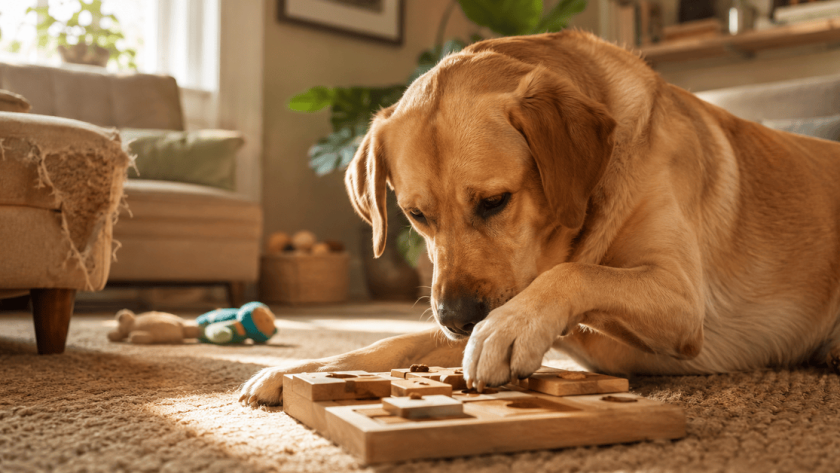
- Slider puzzles — they push and slide compartments to uncover hidden treats
- Snuffle mats — fabric mats that hide food in layers of fleece, mimicking grass foraging
- Lick mats — flat textured mats you spread food onto; the dog licks to get it
- Hide-and-seek toys — soft plush toys where smaller toys or treats are hidden inside
- Multi-step puzzles — require lifting, flipping, and sliding in a specific sequence
Each type works the brain differently. And for an anxious dog, that distinction actually matters.
The Science Behind Why They Help
Here’s the thing — puzzle toys aren’t just a distraction. There’s real neuroscience behind why they calm dogs down, and understanding it changes how you use them.
Your dog’s brain burns real energy
Research from the University of Agricultural Sciences in Sweden found that dogs doing cognitive tasks showed measurable mental fatigue — comparable to what dogs experience after physical exercise. Think about what that means practically. A 15-minute puzzle session can actually tire your dog out. A mentally tired dog is a calmer dog. Full stop.
This is genuinely useful for days when you can’t do a long walk before leaving.
Solving puzzles releases feel-good chemicals
Every time your dog figures out how to get a treat out — even from the simplest puzzle — their brain releases dopamine. That’s the reward chemical, the one linked to pleasure and motivation. Serotonin follows. Over time, these little wins create positive emotional associations with the toy itself, and eventually with the routine around it (which can include you leaving the house).
Licking and chewing are physically calming
This one surprises people. The act of licking — not the food, the physical act of licking — triggers endorphin release. It’s one reason stressed dogs often chew things they shouldn’t. Lick mats and stuffed KONGs channel that same calming mechanism into something safe and structured.
It gives the anxious brain something to do
An anxious dog left alone isn’t thinking “I wonder where my owner went.” They’re in a stress loop — pacing, barking, or destroying things because that nervous energy has nowhere to go. A puzzle toy interrupts that loop. It gives the brain a job. And a dog with a job is a much calmer dog than one left alone with their own thoughts.
Does It Actually Work for Separation Anxiety, Though?
Yes — but with some important nuance that most articles skip over.
For mild to moderate separation anxiety, puzzle toys can make a meaningful difference. The key is timing and association. Give your dog the puzzle toy right before you leave — ideally something high-value like a frozen stuffed KONG. You’re essentially trying to make your departure the signal that something good is about to happen, not something scary.
Done consistently over weeks, this can genuinely reduce the panic response. Some dogs start waiting for the puzzle when they see their owner grab their keys. That’s a huge behavioral shift.
For severe separation anxiety, puzzle toys alone aren’t enough — and it’s important to be honest about that. A dog with true clinical separation anxiety is often too distressed to engage with a toy once you’re gone. The anxiety overwhelms the ability to problem-solve. In those cases, puzzle toys should be one part of a broader plan that includes behavioral therapy, desensitization training, and sometimes medication from your vet.
If your dog is destroying doors, injuring themselves trying to escape, or unable to eat at all when left alone, please talk to your vet before relying on puzzle toys as the main solution.
Trainer tip worth stealing: Before you leave, hide two or three puzzle toys in different spots around the house. Your dog will discover and solve them throughout the day — not just in the first frantic 5 minutes after you walk out the door. It makes the mental stimulation last much longer.
The Four Types of Anxiety Puzzle Toys Can Help
It’s worth separating these out, because the approach differs for each.
Separation anxiety
Already covered above — use high-value, long-lasting puzzles timed to your departure. Frozen KONGs stuffed with peanut butter and banana, snuffle mats, or multi-compartment slider puzzles are all good options here. The goal is duration: you want something that keeps them busy for 20–30 minutes, not 3.
Boredom-driven anxiety
This is honestly where puzzle toys have the biggest impact. A lot of dogs that seem anxious aren’t clinically anxious at all — they’re just bored out of their minds. Working breeds especially: Border Collies, Huskies, Australian Shepherds, German Shepherds. These dogs were bred to work all day. Sitting alone in a house with nothing to do is genuinely torturous for them.
For boredom-driven anxiety, daily puzzle toy sessions can produce visible results within a week. Sometimes less. The dog finally has something to do, and the destructive behavior drops off almost immediately.
If you have a high-energy dog breed, also check out our guide on why the Basenji yodels instead of barking — it’s a good example of how breed-specific behaviors shape what enrichment actually works.
Situational anxiety (thunderstorms, vet visits, guests)
During a storm or when guests arrive, a lick mat spread with something your dog loves can help redirect their nervous energy. It won’t eliminate the fear response — nothing short of medication does that — but it gives their body something to do while the nervous system settles. Think of it as giving their mouth and paws a job so their brain has less bandwidth for panic.
General restlessness and pacing
Some dogs just can’t settle in the evenings. They pace, they whine, they nudge you constantly. Often this is mental under-stimulation catching up with them. A 15-minute puzzle session before you sit down can genuinely transform a restless dog into a sleepy one. The brain is tired. The body follows.
Difficulty Levels: The Part Most People Get Wrong
This is where a lot of well-meaning dog owners accidentally make things worse.
Puzzle toys come in four difficulty levels:
| Level | What It Involves | Best For |
|---|---|---|
| Level 1 — Beginner | One simple action: push, flip, or nudge to reveal treat | Anxious dogs, puppies, seniors, first-timers |
| Level 2 — Intermediate | Two or more steps: slide then lift, for example | Dogs who’ve mastered Level 1 consistently |
| Level 3 — Advanced | Multiple steps in sequence, sometimes with decoy compartments | Experienced, confident puzzle solvers |
| Level 4 — Expert | Complex multi-layer challenges | High-drive, very intelligent breeds |
Here’s the rule that matters most for anxious dogs: always start at Level 1, no matter how smart your dog is.
An anxious dog that can’t solve a puzzle doesn’t think “I’ll try harder next time.” They think “this is overwhelming” and either give up or get more stressed. That’s the opposite of what you want. Confidence has to come first. Easy wins build the positive association with the puzzle. Once that’s established, you can move up slowly.
Starting too hard is genuinely one of the most common mistakes people make — and we’ll cover the rest below.
5 Mistakes That Kill the Effectiveness of Puzzle Toys
1. Starting with a puzzle that’s too difficult
We just covered this, but it bears repeating: frustration doesn’t teach anxious dogs to try harder. It teaches them that puzzles are stressful. Start easy. Build confidence first.
2. Introducing the toy for the first time right before you leave
If the first time your dog ever sees a puzzle toy is the moment you grab your coat and head out the door, that toy is now associated with your departure — which is already a stressor. Introduce the toy during calm, relaxed moments first. Let them explore it with you present. Build the positive association before you use it as a solo tool.
3. Leaving an anxious chewer unsupervised too soon
Some dogs, when stressed, will skip the puzzle-solving part entirely and just destroy the toy. Especially rubber or plastic puzzles. This creates a choking hazard and also means your dog isn’t getting any of the mental benefit. Supervise for the first several sessions. Once you know your dog engages with it safely, you can leave them with it.
4. Using the exact same puzzle every day
Dogs are smarter than we sometimes give them credit for. Once they’ve memorized how a puzzle works, it’s no longer mentally stimulating — it’s just a slow way to eat. The brain isn’t challenged. Rotate toys, mix up formats (snuffle mat one day, treat ball the next), and increase difficulty over time.
5. Expecting puzzle toys to solve severe anxiety on their own
This is the big one. Puzzle toys are a tool, not a treatment. For mild anxiety and boredom, they can do a lot. For clinical separation anxiety, they need to be part of a broader plan. Don’t feel like a failure if your dog’s anxiety isn’t fully resolved by a puzzle toy — it was never meant to carry that whole weight alone.
How to Introduce a Puzzle Toy to a Nervous Dog
If your dog is already anxious, the introduction itself needs to be gradual. Here’s what actually works:
Step 1: Pick the simplest Level 1 puzzle you can find. Simpler than you think you need. Seriously.
Step 2: Load it with something irresistible. Kibble alone isn’t always motivating enough for an anxious dog. Try small pieces of real chicken, cheese, or whatever makes your dog lose their mind with excitement.
Step 3: Let them watch you load it. Sit on the floor with them, place the treats in slowly, let them sniff. No pressure to solve it yet.
Step 4: Guide them gently. Move one compartment yourself so a treat falls out. Let them eat it. They start to understand the cause-and-effect.
Step 5: Praise the attempt, not just the success. Any sniffing, pawing, or nosing at the toy gets verbal praise. The behavior you reward is the behavior that grows.
Step 6: Keep sessions short. 5–10 minutes max at first. End while they’re still engaged and successful — not frustrated.
Step 7: Build a consistent routine. Anxiety eases with predictability. If the puzzle toy appears at the same time every day — especially right before you leave — your dog’s brain learns to anticipate it. That anticipation replaces the dread.
Which Toy Works Best for Which Situation
| Situation | What to Use | Why |
|---|---|---|
| Separation anxiety | Frozen stuffed KONG, snuffle mat | Long-lasting; creates positive departure associations |
| Thunderstorms / noise anxiety | Lick mat with peanut butter or yogurt | Rhythmic licking is physiologically calming |
| Guests or social stress | Slider puzzle in a safe quiet space | Gives them a job and a retreat |
| Boredom and restlessness | Rotating Level 2–3 puzzles | Keeps the brain genuinely challenged |
| Senior dogs | Soft hide-and-seek toys, low-effort snuffle mats | Gentle on joints and jaws; maintains cognitive function |
| Puppies | Simple treat balls, beginner flip puzzles | Builds problem-solving confidence early |
| Large breeds | Sturdy, wide-opening puzzles | Easier for big paws and mouths to manage |
For dogs with specific health concerns, it’s also worth thinking about what goes inside the puzzle. If your dog is on hyaluronic acid supplements for joint health, for example, you’ll want to factor in their overall treat budget when loading up a food puzzle.
Does Breed Matter?
It does, though every dog is an individual.
Working and herding breeds — Border Collies, Huskies, Australian Shepherds, German Shepherds — tend to master puzzles fast and need harder levels or more frequent rotation. They were bred to solve problems all day.
Scent hounds — Beagles, Bloodhounds, Basset Hounds — often respond best to snuffle mats and nose-work puzzles. Smell is their primary sense, and anything that activates it deeply is going to be satisfying. (If you have a Basset Hound, our piece on whether Basset Hounds can swim might also be useful for thinking about their physical enrichment needs.)
Brachycephalic breeds — Bulldogs, Pugs, French Bulldogs — need puzzles with wider openings. Their flat faces make it difficult to dig treats out of narrow compartments, which can lead to frustration rather than engagement.
Senior dogs benefit enormously from regular puzzle sessions to maintain cognitive function and slow cognitive decline — but choose lower-effort formats that don’t require a lot of physical manipulation.
When Puzzle Toys Are Not the Answer
Be honest with yourself about this:
If your dog is destroying doors or windows trying to escape when you leave, puzzle toys won’t fix that. That’s severe separation anxiety and needs professional intervention.
If your dog has resource guarding tendencies, food puzzles can actually trigger guarding behavior — get guidance from a trainer before using them.
If your dog is recovering from surgery, physical manipulation of a puzzle toy might be too taxing. Stick to lick mats and pure scent activities instead.
If your dog is on a restricted diet, account for puzzle treats in their daily food intake. It’s easy to accidentally overfeed when you’re using food as enrichment throughout the day.
Frequently Asked Questions
How long should my dog use a puzzle toy each session? Somewhere between 10 and 20 minutes is usually the sweet spot. Mental stimulation is more tiring than people expect — even a short session can genuinely wear a dog out. Watch for signs of frustration (pawing aggressively, barking at the toy, walking away) and end on a win before you get there.
Can I leave my dog with a puzzle toy when I go out? Once you know how your dog engages with it safely, yes. But don’t assume that on day one. Some dogs get frustrated and destroy the toy. Supervise the first handful of sessions, then make the call based on what you’ve seen.
How often should dogs use puzzle toys? Daily, ideally — especially for anxious or high-energy dogs. Even 15 minutes a day builds cumulative benefit over weeks.
Are puzzle toys safe? Look for BPA-free, food-safe materials. Inspect them regularly for cracks or wear. Retire any toy that’s showing damage — pieces can become choking hazards.
My dog completely ignores the puzzle toy. What now? Go simpler and go higher value. Use real food, not just kibble. Sit with them and demonstrate. Some dogs need 3–4 sessions before the light bulb comes on. Never force it — make it feel like a game, not a task.
Can puzzle toys replace exercise? Not entirely. Dogs need physical exercise and outdoor stimulation for their wellbeing. But on days when a long walk isn’t possible, a good puzzle session is far better than nothing and genuinely compensates for some of the mental energy that exercise would have burned.
The Bottom Line
Puzzle toys for dogs with separation anxiety genuinely work — but they work best when you understand why they work, start at the right difficulty level, and build a consistent routine around them.
They’re not a magic cure. But for mild to moderate anxiety and especially for boredom-driven stress, they’re one of the most practical, affordable, and enriching tools available to dog owners. The science backs it up. Thousands of dog owners have seen real results. And they’re a lot cheaper than replacing a door frame.
Start with a Level 1 puzzle, load it with something your dog loves, and give it a genuine few weeks before you judge the results. You might be surprised.
Have you tried puzzle toys with your dog? Drop a comment — we’d love to know which ones actually worked (and which ones ended up in pieces on the floor).