
 Darren Wills
 When your cat is losing weight even though it eats all the time, then something fishy is going on. One of the most prevalent hormonal disorders of older cats is hyperthyroidism. It is life-threatening when untreated.
This article will highlight symptoms of late-stage hyperthyroidism in cats, including effects on the cat’s eyes, digestion, behavior, and health in general. You will also get to know what to expect during the later stages of feline hyperthyroidism.
What Is Hyperthyroidism in Cats?
Your cat has a thyroid gland that is located in its neck. It regulates metabolism, heart rate, and energy levels. In hyperthyroidism, the gland secretes excessive amounts of hormones.
These lead to the body’s overdrive. All systems are impacted. The majority of cases occur in cats older than 10 years. It is among the most common cat diseases in veterinary practice.
The first indications are not hard to overlook. Cats appear to be very active, hyperactive. However, with time, the disease advances and damages vital organs.
Does Hyperthyroidism in Cats Progress with Age?
Yes. Without treatment, hyperthyroidism becomes much worse.
During infancy, the thyroid gland secretes a small amount of thyroid hormone. Hormone levels continue to increase as the disease progresses. It affects the heart, kidneys, liver, and brain.
The longer the condition is left unmanaged, the more difficult it is to cure. Many cat owners notice symptoms only when the disease is already in its late stages.
Late-Stage Symptoms of Feline Hyperthyroidism
The late-stage symptoms of hyperthyroidism in cats are more intense than the early ones. The cat’s body can no longer able to compensate for the excess thyroid hormone.
The following are the warning signs to be observed.
1. Extreme and Rapid Weight Loss
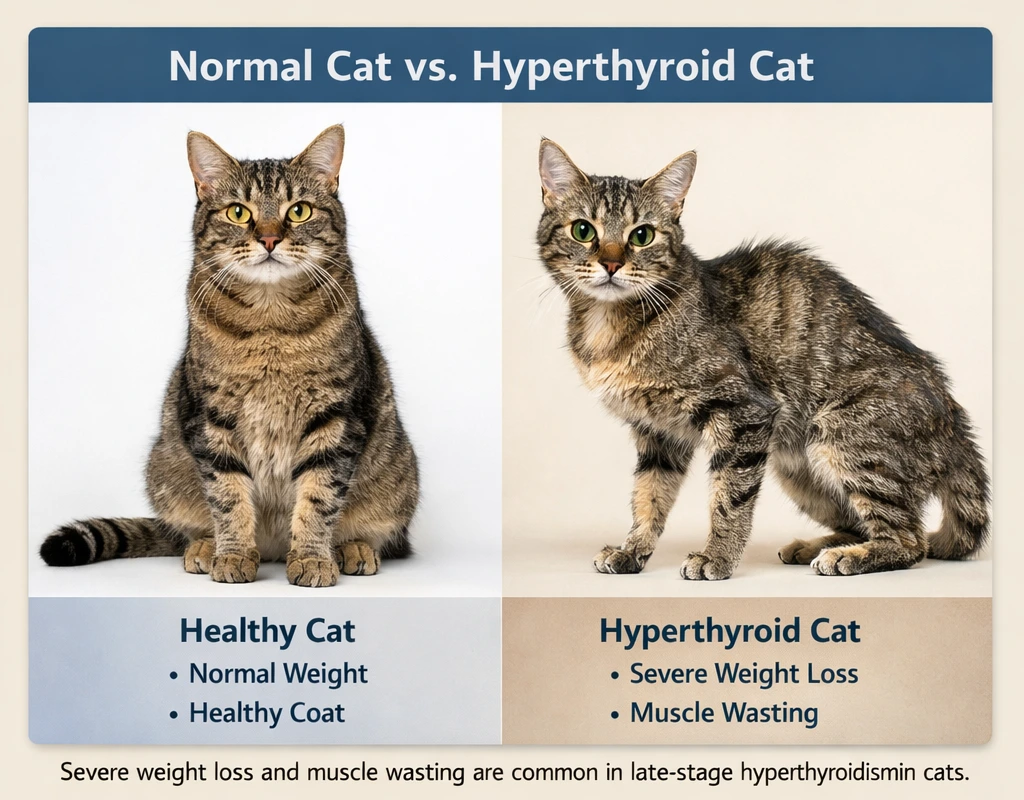
In later stages of feline hyperthyroidism, the loss of weight becomes severe. Even though your cat may be eating a lot, it might appear skinny. Muscle wasting can be observed in the back and shoulders. This is referred to as cachexia. The body is consuming more energy than it can absorb.
2. Vomiting at Late-Stage Hyperthyroidism
Late-stage cases are characterized by frequent and severe vomiting. It is not one of those hairballs. The cat can vomit daily or multiple times a day.
This irritates the stomach lining because of excess thyroid hormone. Gut motility is enhanced, and food moves too rapidly along the digestive tract. This causes inefficient uptake of nutrients.
Vomiting can include undigested food, bile, or yellow-green fluid.
3. Diarrhea and Stool Alterations
Diarrhea is also accompanied by vomiting. Stools can be soft, loose, and oily. The activity of the gut is further increased, preventing water absorption to taking place. Cats can have accidents outside the litter box.
4. Heart Issues and Breathing Problems
One of the organs most affected by excess thyroid hormone is the heart. The heart muscle becomes thick and overworks itself. This scenario is referred to as hypertrophic cardiomyopathy.
In late stages, this causes:
- Irregular heartbeat and heart murmurs. Quick heartbeat, even when at rest. The accumulation of fluid in the lungs or the chest.
- Difficult breathing or open-mouth breathing. Collapse and exercise intolerance after mild exercise.
5. Ocular Changes – Altered Eye Appearance
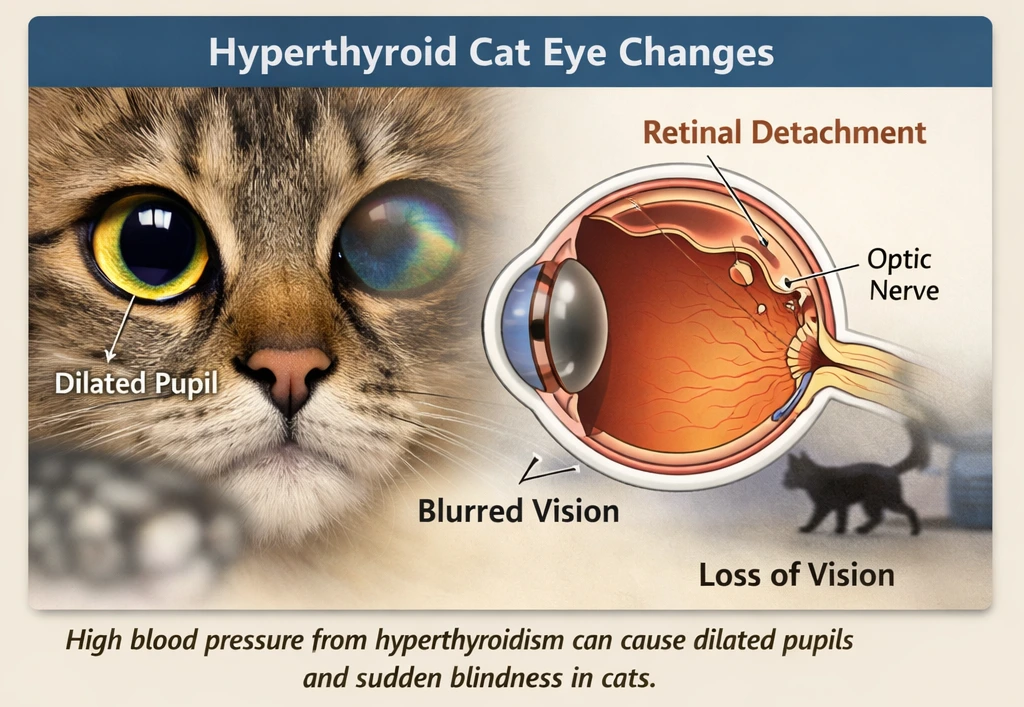
This is among the more frightening symptoms. Eye problems arise due to the increase in blood pressure. Untreated hyperthyroidism in cats is directly related to high blood pressure.
Typical ocular alterations are:
- Enlarged pupils that fail to constrict in response to light. The pupils can be dilated even in bright conditions.
- One of the severe complications is retinal detachment. The retina detaches itself at the back of the eye. Cats can go blind. You can find your cat going into walls and seeming lost.
If you notice any changes in your cat’s eyes, visit a veterinarian immediately. High blood pressure can cause permanent vision loss in hours.
These are dire indications. Untreated cats may develop heart failure quickly.
What Happens When the Feline Hyperthyroidism Goes Unchecked?
In the absence of treatment, the disease progresses to organ failure.
The heart gets enlarged and later turns out to fail. Kidney disease worsens. The cat will be completely unresponsive to nutrient absorption. High blood pressure ruins the eyes, brain, and kidneys.
The final stages involve total loss of appetite, inability to stand, difficulty breathing, convulsions, and extreme confusion. At this stage, the standard of living is very low.
Can Hyperthyroidism Cause Sudden Death in Cats?
Yes, in some cases. Sudden death can occur due to severe heart problems, e.g., sudden heart failure or a blood clot (thromboembolism).
A clot in the blood is manifested by sudden collapse or paralysis of the hind legs. It is an emergency in medicine. Take your cat to a doctor.
13 or 17 Year Old Cat With Hyperthyroidism: What to Expect
Even the elderly cats can be treated well. Age is not a sufficient reason to neglect disease management.
- The treatment will comprise daily medication (methimazole), the prescription of a low-iodine diet, the use of radioactive iodine, or surgery.
- The primary issue in very old cats is concurrent kidney disease. The veterinarian will closely monitor kidney function, particularly while the treatment is ongoing.
- In cats of 15 to 17 years, proper management can greatly prolong life. Many treated cats survive a few more years.
- Collaborate with your vet to identify the safest option for your older cat.
When to See a Vet?
Do not wait if your cat displays any of the following:
- Acute vision loss or eye opacification. Breathing with an open mouth or a fast heartbeat. Weakness or collapse of the hind limbs. Not taking food for over 24 hours. Serious or frequent vomiting.
- These are emergencies. There is a difference between early intervention and outcomes.
The guide on Hyperthyroidism in Cats gives detailed clinical information on diagnosis and management options.
Final Thoughts
The symptoms of late-stage hyperthyroidism in cats are severe and gradual in the late stage. There is a change in the appearance of the eyes, constant vomiting, heart issues, and excessive loss of weight, which are red flags and require immediate treatment.
Your cat cannot say that he/she feels bad. And their body does. This is because knowing what to look for makes you act before the disease reaches its final stages.
When any of these signs are exhibited by your elderly cat, call your veterinarian today. With an early diagnosis and appropriate treatment, you can help your cat be comfortable and live longer.
FAQs
What are the initial symptoms of hyperthyroidism in cats?
The initial symptoms are weight loss, although appetite is good, increased thirst, frequent urination, hyperactivity, and a coarse coat. These symptoms normally come slowly.
What is the rate of hyperthyroidism in cats?
It develops in months to years. Symptoms gradually deteriorate in the absence of treatment. It can result in late-stage complications one to two years after onset.
Could hyperthyroidism be treated in cats?
The use of radioactive iodine treatment in most cases is a permanent cure. It is non-toxic and very efficient. The disease is not permanently cured but only controlled with medication.
Does hyperthyroidism kill cats?
Yes, otherwise. It causes the failure of the heart and the kidneys, and other complications that are life-threatening. The prognosis of treated cats is great.
Does a hypertrophic cat have a normal appetite?
Yes, during their early stages. Later on, poor appetite can lead to weight loss due to vomiting and malabsorption of nutrients in the late stages. A prescription diet may help.


