 Guest Author
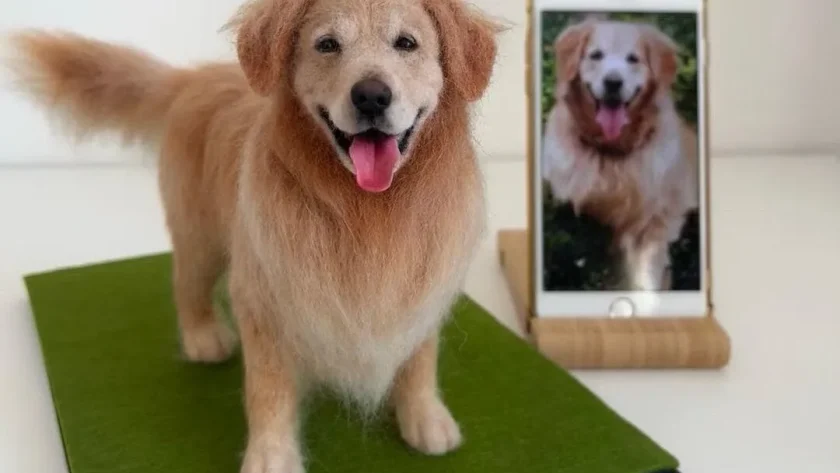
People send me photographs of their pets every week: a dog asleep in a patch of sun, a cat mid-yawn, a rabbit caught halfway through a hop. My job is to turn those flat images back into something with weight and shape: a needle felted replica, built entirely by hand.
A photograph is a wonderful thing, but it stays behind glass or on a phone screen. What owners actually miss, especially after a pet has died, is presence: the shape on the sofa, the size of the animal curled against a leg. A custom pet replica cannot give the animal back, and it doesn’t pretend to. What it can do is give the hands something true to hold.
When sharing photographs of a pet online, it’s also worth taking a moment to consider their privacy and where those images might be used.
Unlike a mass-produced plush pet replica, each handmade felted pet is individually shaped using wool, reference photographs and careful attention to the animal’s features.
Why the Photos Matter More Than Anything
Every commission starts with far more photos than you’d expect. I ask for the front, both sides, and a view from above; close-ups of the face, the tail, and any markings; and at least one picture taken outdoors in plain daylight, because indoor light and flash lie about coat colour. Blurry old photos are welcome as supporting evidence. They often capture the expression best.
The most useful photograph is rarely the prettiest one. It’s the one where the ears sit the way they always sat, where the head tilts the way it tilted when a biscuit tin opened. I keep coming back to that picture for the whole build, because likeness lives in those habits, not in a perfect pose.
A Skeleton of Wire and Wool
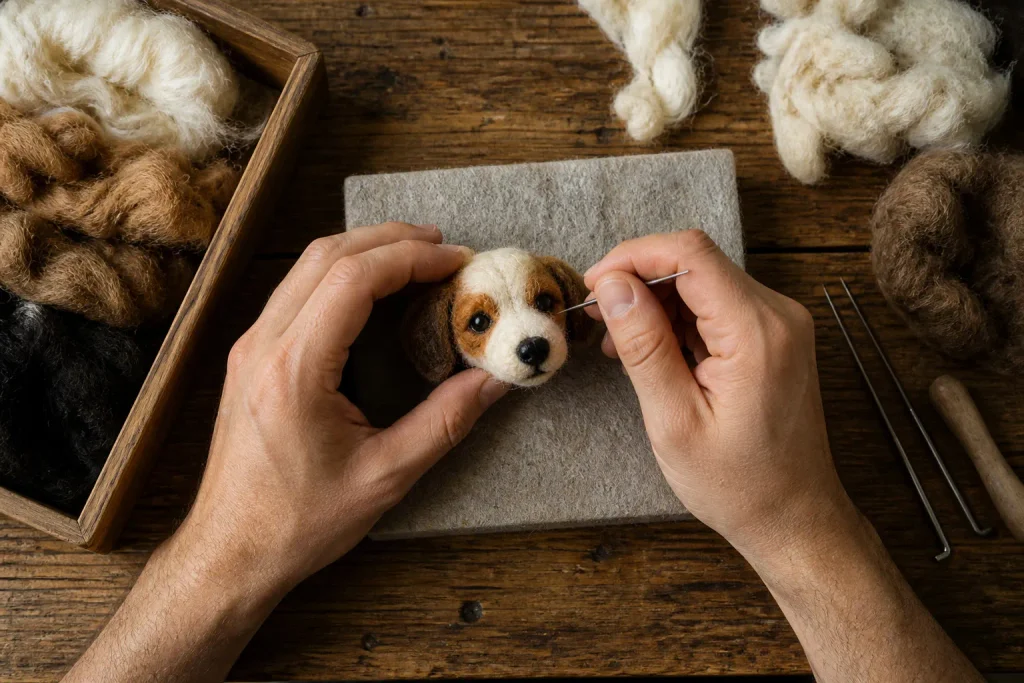
Standing and larger pieces begin with an armature: a simple skeleton of bendable aluminium wire for the spine, legs, and tail, so the finished animal holds its pose. Around that I wrap core wool, the undyed carded batting that forms the body, and begin the long work of felting: driving a barbed needle in and out, thousands upon thousands of times, until the fibres tangle into something firm and solid.
I use a coarse 36-gauge needle for this stage. It is slow, unglamorous work, and it decides everything. Chest depth, the angle of the neck, the length of the back: if the shape underneath is wrong, no amount of beautiful fur on top will rescue it.
Shape First, Surface Later
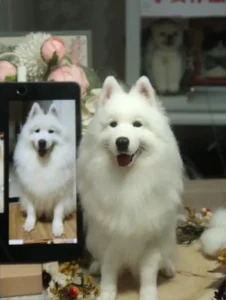
Before any colour goes on, I build the entire animal in plain core wool: a pale, hairless version of the pet.
This is when I set the ears, lengthen or shorten the muzzle, and add the small truths a camera records: the slight sway in an old dog’s back, one shoulder a touch lower than the other.
Proportions are easy to correct at this stage and nearly impossible later, so the grey ghost on my turntable gets turned and stared at for a long while before I move on.
Size and pose are decided here too, together with the owner. A small desktop piece might sit in the alert, ears-up pose the animal used at the window.
Larger pieces are often built lying down, curled the way the pet actually slept, because that is the shape the household remembers. Getting that decision right matters more than any detail I add afterwards.
The Coat, Layer by Layer
The visible coat comes from finer wool: merino tops or Corriedale roving, depending on the animal. These are laid in small sections in the direction the fur actually grows and anchored with a finer 40-gauge needle. Long coats are built up tuft by tuft. For a fluffy finish I use a reverse needle, whose barbs pull fibres outward instead of pushing them in, teasing the surface up into something soft rather than slick.
Colour is the quiet obsession of this work, because almost no animal is a single colour. A “black” dog usually carries warm brown where the sun reached him and grey creeping into the muzzle; a ginger cat is four oranges arguing with each other. I blend shades strand by strand, then check the result against the photos: up close, at arm’s length, and in different light, and adjust. Markings get the same treatment: the blaze that runs wider on one side, the single spotted paw, the tabby striping that fades out along the belly. Symmetry is easy. Animals aren’t symmetrical, and the replica shouldn’t be either.
The Face Is the Whole Job
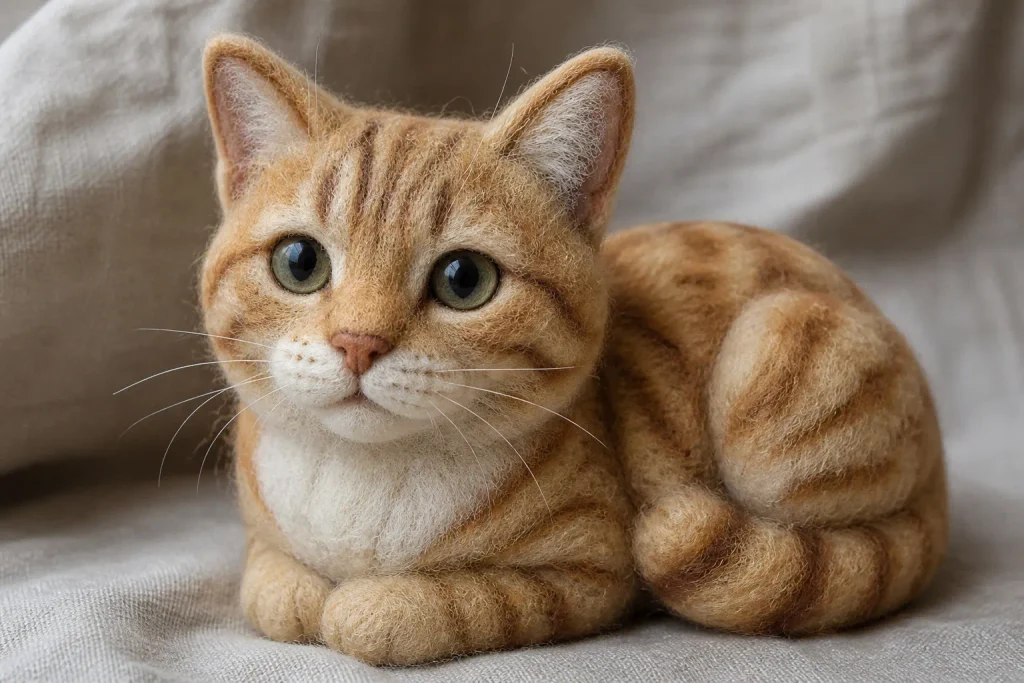
Everything converges on the face. I set glass eyes into felted sockets and then adjust them in fractions: a hair deeper, a hair wider apart, because expression lives in those fractions. The nose is either sculpted or felted tight and finished to a soft sheen; the mouth is a single, careful line. Whiskers go in last, one at a time, usually horsehair or fine monofilament, and they take longer than visitors ever guess.
Finishing and Why People Commission One
The last pass is a trim, a final comparison against every photograph, and a check that the piece sits or stands the way the animal did. Start to finish, a replica takes three to six weeks, and a large, life-size piece can run past a hundred hours of needle work. There is no way to hurry it; felt remembers haste.
People commission these pieces at different moments. Some order while a pet is old but still very much here, as a portrait sitting in wool. Some order after a loss, sometimes months after, when the house has gone quiet. Some are gifts for someone else who is grieving.
What they receive is not a toy and not an ornament. It is the size and shape of one particular animal, made slowly, from that animal’s own photographs. For many owners, a handmade pet replica becomes a meaningful pet memorial keepsake, something different to have in the house than a picture of them.
About the Author
Wei is the maker behind SoulNest Pets, a small studio creating custom needle felted pet replicas from photos. Each piece is sculpted by hand over three to six weeks. You can see how a custom pet memorial is made from your photos and how the ordering process works on the studio’s site.