 Darren Wills
Cockatiels are affectionate, intelligent parrots known for their distinctive crests, orange cheek patches, and playful personalities. They can make wonderful companions, but adopting one also means taking on a long-term responsibility. So, exactly how long do cockatiels live?
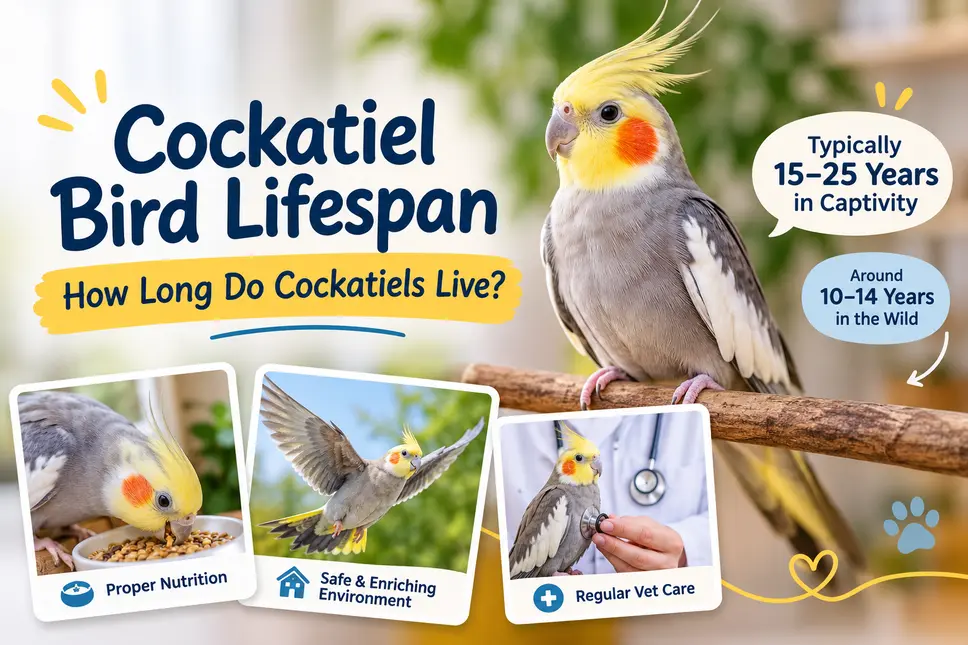
A pet cockatiel can have a lifespan of approximately 15 to 25 years in captivity with appropriate care.
However, this is a commonly cited potential lifespan rather than a guarantee or a consistent average across all populations. Individual birds may live shorter or longer lives depending on genetics, nutrition, living conditions, and access to veterinary care.
Wild cockatiels generally face more environmental challenges, including predators, drought, food shortages, and disease. Their reported lifespan is approximately 10 to 14 years.
Understanding the cockatiel bird lifespan can help you make informed decisions about adopting, feeding, and caring for your feathered companion.
Let’s explore their life expectancy, different life stages, common health concerns, and practical ways to support a longer, healthier life.

How Long Do Cockatiels Live?
Cockatiels kept as pets can potentially live for 15 to 25 years, although their actual life expectancy varies considerably.
The difference between reported lifespan figures often comes down to the type of data being measured. Some references describe the potential lifespan of a well-cared-for pet, while veterinary population studies examine how long birds typically survive in particular groups.
For a general comparison, here are commonly reported figures:
| Cockatiel type | Reported lifespan |
|---|---|
| Wild cockatiel | Approximately 10–14 years |
| Pet cockatiel | Approximately 15–25 years of potential lifespan |
| Exceptional captive lifespan | Some individuals have lived beyond 30 years |
These figures are estimates, not guarantees. A cockatiel’s actual lifespan depends on its health history, environment, and daily care.
What Is the Average Lifespan of a Pet Cockatiel?
The average lifespan of a cockatiel bird is commonly quoted as 15 to 25 years in captivity. However, some veterinary datasets report shorter median or average survival figures.
For example, the Association of Avian Veterinarians’ senior-parrot care information lists a median life expectancy of approximately nine years in captivity, while also documenting a longevity record of 35 years for cockatiels.
This distinction is important: a bird’s potential lifespan is not necessarily the same as the age most birds in a population reach.
With proper nutrition, suitable housing, regular health examinations, and consistent attention, a pet cockatiel has a better opportunity to enjoy a long life.
How Long Do Cockatiels Live in the Wild?
Wild cockatiels generally have a reported lifespan of approximately 10 to 14 years.
Native to Australia, these birds inhabit open woodlands, grasslands, and semi-arid environments. They travel in flocks, forage for seeds and other natural foods, and move between areas depending on food and water availability.
Life outside captivity exposes them to several challenges:
- Predators: Birds of prey and other animals can threaten their survival.
- Drought: Limited access to water can become a serious problem.
- Food shortages: Seasonal changes may affect the availability of seeds and other food.
- Injuries and infections: Wild birds do not have regular access to veterinary treatment.
- Environmental conditions: Extreme temperatures and changing weather can affect their health.
Pet cockatiels generally benefit from protection against many of these threats, but indoor living does not automatically guarantee a longer lifespan.
Does Captivity Increase a Cockatiel’s Lifespan?
Cockatiel lifespan in captivity can be longer than in the wild when birds receive appropriate care.
Pet birds generally have more consistent access to food, clean drinking water, shelter, and medical attention. Their owners can also monitor changes in weight, appetite, behavior, and activity.
However, poor captive conditions can create serious health risks.
A cockatiel fed an unbalanced seed-heavy diet, kept in an unsuitable cage, or exposed to household fumes may develop preventable health problems.
A healthy captive environment should provide:
- A spacious and secure cage.
- A nutritionally appropriate diet.
- Safe perches and enrichment activities.
- Opportunities for supervised exercise and flight.
- Regular interaction and mental stimulation.
- Preventive examinations by an avian veterinarian.
Cockatiel Age Chart: Understanding Different Life Stages
Cockatiels experience several developmental stages as they grow from dependent chicks into mature adults and eventually senior birds.
Understanding these stages helps owners recognize how their bird’s nutritional, behavioral, and healthcare needs may change.
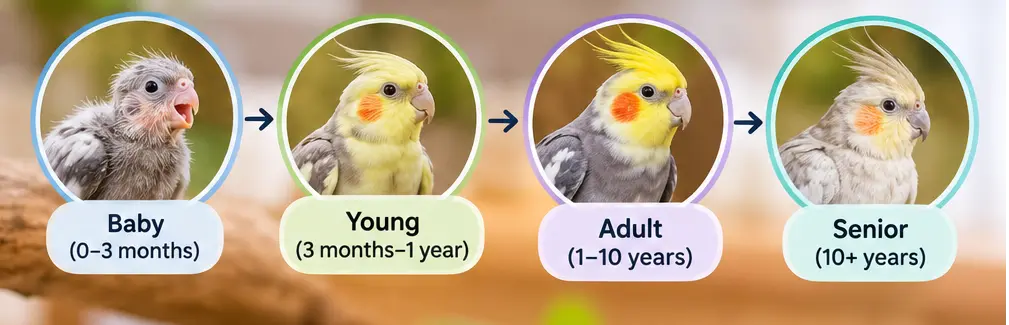
Here is a general cockatiel age chart:
| Life stage | Approximate age | What to expect |
|---|---|---|
| Baby cockatiel | 0–3 months | Feather development, growth, and dependence on caregivers |
| Young cockatiel | 3 months–1 year | Increasing independence and development of adult behaviors |
| Adult cockatiel | 1–10 years | Physical maturity, activity, and established behavior |
| Senior cockatiel | 10–12 years and older | Possible age-related changes and increased need for health monitoring |
These are practical age ranges rather than strict veterinary classifications. Individual birds can mature and age differently.
Baby Cockatiels (0–3 Months)
Baby cockatiels require considerable care during their early development.
They begin life with limited mobility and depend on their parents or experienced caregivers for feeding, warmth, and protection. As they grow, their feathers develop, coordination improves, and they gradually learn to eat independently.
During this stage, appropriate nutrition and a safe environment are particularly important.
If you are adopting a baby cockatiel, make sure it is fully weaned and eating independently. Hand-feeding an unweaned bird without appropriate training can cause serious complications, including aspiration and crop-related problems.
Young Cockatiels (3 Months–1 Year)
Young cockatiels become increasingly curious and active as they develop.
They start exploring their surroundings, climbing, playing with toys, and practicing whistles and other vocalizations. Their personalities also become more noticeable.
Cockatiels generally develop mature physical characteristics after their first molt, which commonly occurs around 9–12 months.
This is a good time to establish positive training habits, introduce appropriate enrichment, and develop a consistent feeding routine.
Adult Cockatiels (1–10 Years)
Adult cockatiels are generally physically mature and often display established personalities and social preferences.
They enjoy activities such as climbing, playing, exploring, and interacting with their owners.
Maintaining a balanced diet and providing regular opportunities for exercise are important during this period.
Adult females may also experience reproductive health concerns, including repeated egg-laying, even when no male is present.
Senior Cockatiels (10–12 Years and Older)
Cockatiels may begin showing age-related changes as they enter their senior years.
The Association of Avian Veterinarians identifies cockatiels older than 12 years as geriatric in its senior-parrot care guidance.
Older birds may experience changes in mobility, activity, weight, and overall health. Some may also develop conditions that require closer veterinary monitoring.
Senior cockatiels may benefit from:
- Easily accessible food and water.
- Comfortable perches with appropriate widths and textures.
- A balanced diet suited to their health requirements.
- Regular veterinary examinations.
- A predictable daily routine.
- Gentle activities that encourage movement without causing exhaustion.
Remember that sudden weakness, appetite changes, breathing problems, or difficulty balancing should not simply be attributed to old age.
Do Male and Female Cockatiels Have Different Lifespans?
There is no established universal rule that male cockatiels live longer than female cockatiels or vice versa.
Both sexes can enjoy long lives when provided with suitable nutrition, safe housing, exercise, and veterinary attention.
However, female cockatiels have certain reproductive health concerns that owners should understand.
Female cockatiels can lay eggs even when they have never been housed with a male. Repeated egg-laying may place additional demands on their bodies and contribute to calcium depletion.
One potentially serious complication is egg binding, a condition in which a female bird cannot pass an egg normally.
Warning signs can include:
- Sitting at the bottom of the cage.
- Weakness or unusual tiredness.
- Straining or difficulty passing droppings.
- A swollen abdomen.
- Tail bobbing or difficulty breathing.
Egg binding is a veterinary emergency and requires prompt medical attention.
Male cockatiels do not experience egg-laying complications, but they can develop other health conditions. Their overall life expectancy still depends on genetics, nutrition, environment, and healthcare.
Rather than choosing a bird based on assumptions about which sex lives longer, consider its health history, temperament, and individual care requirements.
Does Cockatiel Color Affect Its Lifespan?
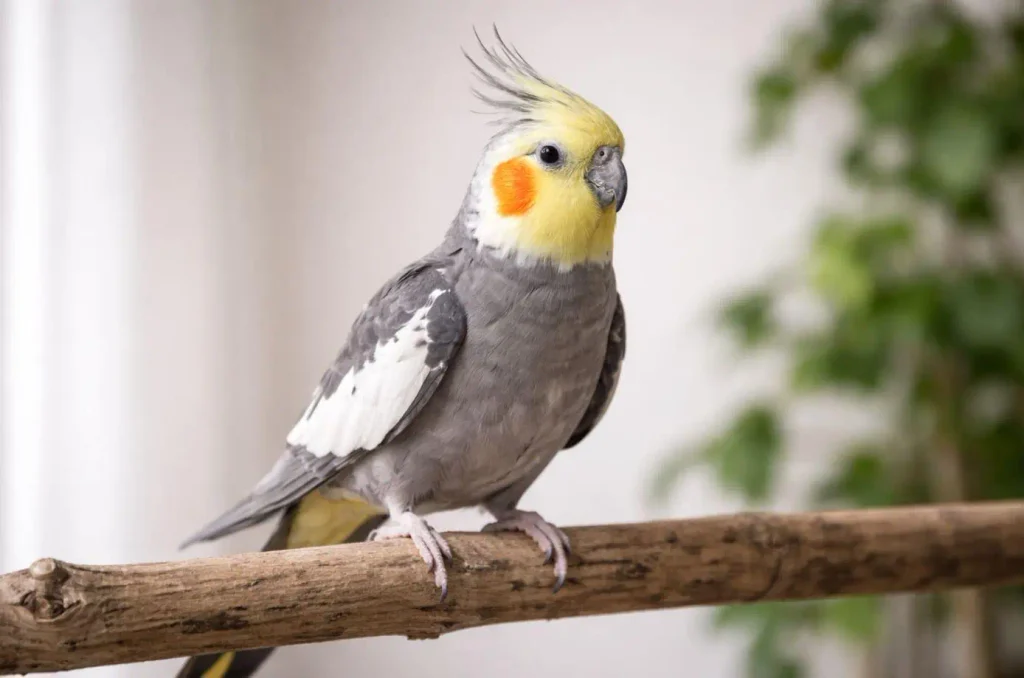
Cockatiels come in several attractive colors and feather patterns. Some common varieties include:
- Normal grey.
- Lutino (yellow or white with orange cheek patches).
- Pied.
- Pearl.
- Cinnamon.
- White-faced.
Some owners wonder whether a yellow cockatiel has a shorter lifespan than a traditional grey cockatiel.
There is no reliable universal lifespan difference established by feather color alone.
A healthy yellow or lutino cockatiel can potentially live as long as a healthy bird with traditional grey coloring.
However, genetics and breeding practices still matter. Certain breeding lines may carry inherited health concerns, and poor breeding practices can increase the risk of genetic problems.
When choosing a cockatiel, pay attention to its overall health rather than its appearance alone.
Look for:
- Bright, clear eyes.
- Clean nostrils and normal breathing.
- Smooth, well-maintained feathers.
- Normal movement and coordination.
- Alert and responsive behavior.
- Healthy-looking feet and legs.
Ask the breeder about the bird’s age, parent birds, health history, and any known inherited conditions.
A yellow cockatiel’s lifespan cannot be predicted simply by its feather color.
7 Important Factors That Affect a Cockatiel’s Lifespan
Several factors influence how long a cockatiel lives. While genetics and individual health play a role, everyday care can make a meaningful difference.
Here are seven important considerations.
1. Diet and Proper Nutrition
Nutrition is one of the most important parts of maintaining a cockatiel’s health.
A diet consisting entirely of seeds may not provide all the nutrients a pet bird needs. Although seeds are a natural part of a cockatiel’s diet, relying on them exclusively can contribute to nutritional imbalances.
A suitable diet may include:
- Formulated pellets: An appropriate cockatiel pellet can provide essential nutrients.
- Vegetables: Offer suitable vegetables such as broccoli, carrots, leafy greens, and bell peppers.
- Fresh fruit: Small portions of appropriate fruits can provide variety.
- Seeds: Include suitable seeds in moderation as part of a balanced feeding plan.
- Fresh water: Provide clean drinking water every day.
Avoid feeding your cockatiel avocado, chocolate, alcohol, caffeine, and heavily salted foods.
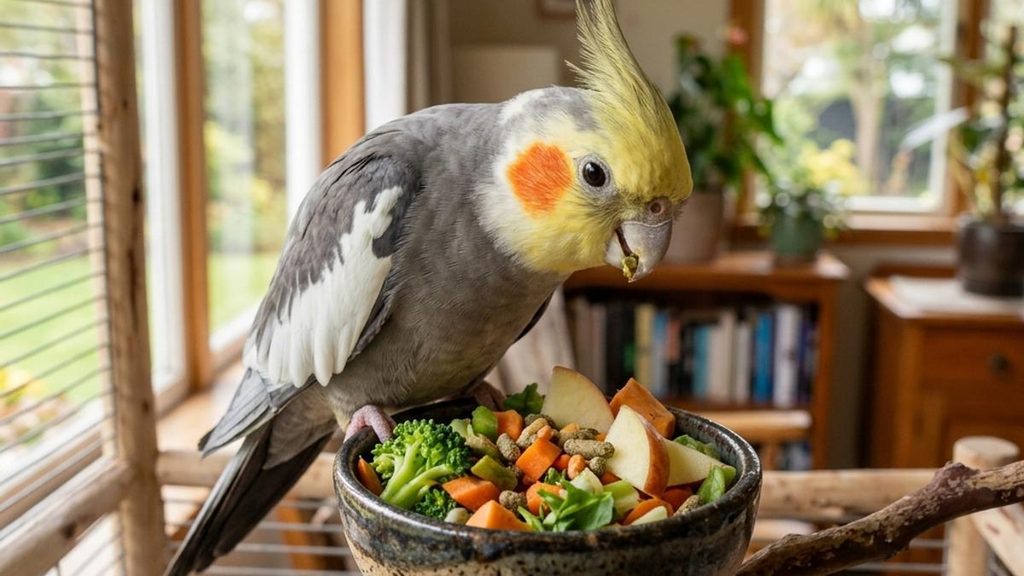
Dietary requirements can vary, and recommendations for pellet and seed proportions differ between veterinary sources. An avian veterinarian can help establish an appropriate feeding plan.
If your bird currently eats mostly seeds, do not suddenly replace its entire diet with pellets. Introduce changes gradually and monitor its weight and food intake.
2. Clean and Safe Housing
A suitable living environment protects cockatiels from injuries, infections, and unnecessary stress.
Choose a spacious cage that allows your bird to stretch its wings, climb, and move comfortably. The bar spacing should also be appropriate for a cockatiel to prevent its head or body from becoming trapped.
The cage should include:
- Secure food and water containers.
- Perches of different sizes and textures.
- Safe toys and climbing opportunities.
- Sufficient room for comfortable movement.
- A clean, dry cage base.
Clean food and water containers regularly, remove droppings, and discard leftover fresh food before it spoils.
Avoid placing the cage near extreme temperatures, direct drafts, or areas where the bird experiences constant disturbance.
3. Exercise and Daily Activity
Cockatiels are naturally active birds. They need opportunities to move, climb, stretch, and use their wings.
Limited activity can contribute to obesity, muscle weakness, and behavioral problems.
Provide supervised out-of-cage time in a bird-safe room whenever possible.
There is no single number of hours that suits every cockatiel. The appropriate amount depends on the bird’s health, activity level, and environment.
Before allowing your bird to explore, make sure you:
- Close windows and doors.
- Switch off ceiling fans.
- Remove access to hot cooking surfaces.
- Keep other pets away.
- Remove dangerous objects and household hazards.
You can also encourage movement with climbing ladders, natural wooden perches, play stands, and bird-safe toys.
4. Social Interaction and Mental Stimulation
Cockatiels are naturally social birds that often enjoy communicating and spending time with others.
A cockatiel that receives very little attention may become bored, stressed, or develop behavioral problems such as excessive screaming or feather-damaging behavior.
Spend time interacting with your bird every day.
Useful activities include:
- Gentle talking and whistling.
- Simple training sessions.
- Rotating safe toys.
- Foraging activities.
- Positive reinforcement.
- Supervised playtime.
If you keep only one cockatiel, remember that you will need to provide consistent social interaction and mental stimulation.
5. Genetics and Responsible Breeding
Genetics can influence a cockatiel’s overall health and potential lifespan.
A bird from a responsible breeder with healthy parent birds may have a better starting point than one produced through careless breeding practices.
Before adopting, ask about the bird’s breeding background, hatch date, weaning history, and known health concerns.
Avoid breeders who cannot provide basic information about the bird’s age, health, or living conditions.
Even a bird with a healthy genetic background still needs appropriate daily care.
6. Preventive Veterinary Care
Regular veterinary examinations can help identify potential health concerns before they become serious.
Birds often hide signs of illness, meaning a cockatiel may appear relatively normal even when something is wrong.
Arrange an initial examination with an avian veterinarian after bringing home a new bird. Your veterinarian can recommend an appropriate schedule for routine checkups based on its age and health.
Examinations may include:
- Weight and body condition checks.
- Feather and skin assessment.
- Beak and nail examination.
- Foot and leg assessment.
- Breathing and general health evaluation.
- Additional tests when medically necessary.
If your cockatiel stops eating, becomes unusually quiet, has difficulty breathing, or shows sudden changes in behavior, contact a veterinarian promptly.
7. A Safe Home Environment
Household hazards are an important but sometimes overlooked factor affecting a cockatiel’s health.
Birds have sensitive respiratory systems, and exposure to certain fumes can cause severe injury or even sudden death.
Keep your cockatiel away from:
- Overheated nonstick cookware and appliances containing PTFE.
- Cigarette smoke and vaping products.
- Aerosol sprays and strong chemical cleaners.
- Scented candles and air fresheners.
- Ceiling fans and hot cooking surfaces.
- Open windows and unsecured doors.
- Other pets that may chase or injure the bird.
- Small objects containing lead or zinc.
Pay particular attention to the kitchen. Cooking fumes and overheated nonstick coatings can pose serious risks to pet birds.
A bird-safe home helps reduce preventable accidents and toxic exposure.
How to Help Your Cockatiel Live a Longer, Healthier Life
Understanding what affects a cockatiel’s lifespan is only the first step. Consistent daily care is what helps support its long-term well-being.
Here are some practical habits every cockatiel owner should follow.
1. Provide a balanced diet. Offer an appropriate combination of formulated pellets, vegetables, and suitable seeds and other foods according to your veterinarian’s recommendations.
2. Keep fresh water available. Replace drinking water daily and clean water containers regularly.
3. Encourage daily activity. Provide opportunities for climbing, playing, and supervised out-of-cage movement.
4. Spend quality time together. Talk to your cockatiel, offer gentle interaction, and introduce activities that encourage mental engagement.
5. Maintain a clean cage. Remove droppings and spoiled food regularly. Wash food and water dishes to reduce contamination.
6. Protect your bird from household hazards. Be particularly careful around kitchens, cleaning products, smoke, and chemical fumes.
7. Arrange regular veterinary examinations. Work with an avian veterinarian who understands the healthcare requirements of companion birds.
8. Maintain a consistent sleep routine. Provide a quiet, dark, and undisturbed sleeping environment every night.
9. Monitor weight and behavior. Changes in appetite, droppings, activity, or body weight may be early indicators of health problems.
10. Adjust care as your bird ages. Older cockatiels may need easier access to food and water, comfortable perches, and additional health monitoring.
These habits cannot guarantee a particular lifespan, but they can reduce preventable health risks and support a better quality of life.
Signs Your Cockatiel May Be Getting Older
As cockatiels age, you may notice changes in their appearance, activity, and behavior.
However, aging does not automatically mean a bird should become inactive or lose interest in its surroundings.
Here are some changes you may notice in an older cockatiel.
Reduced activity: A senior cockatiel may spend more time resting and show less interest in energetic play.
Changes in mobility: Some older birds may find climbing or balancing more difficult, particularly if they develop joint or foot problems.
Changes in sleeping habits: Older birds may rest more frequently or show changes in their usual sleeping routine.
Changes in feather condition: Feather quality can change, but poor feather condition may also indicate nutritional deficiencies, stress, or illness.
Changes in weight: Older birds may experience weight changes due to differences in activity, appetite, or underlying medical conditions.
Less interest in certain activities: An older cockatiel may become less interested in toys or activities it previously enjoyed.
These changes should not automatically be dismissed as normal aging.
Birds can hide discomfort, and symptoms such as reduced appetite, sudden weakness, breathing difficulties, abnormal droppings, or loss of balance require prompt veterinary attention.
If you notice significant changes, arrange an examination with an avian veterinarian rather than assuming your cockatiel is simply getting old.
Frequently Asked Questions About Cockatiel Lifespan
How long can a cockatiel live?
A pet cockatiel can potentially live for approximately 15 to 25 years with appropriate care. Some individuals have lived beyond 30 years, although these are exceptional cases rather than typical expectations.
Can a cockatiel live for 20 years?
Yes. A cockatiel can certainly live for 20 years, which falls within the commonly reported potential lifespan for well-cared-for pet birds.
Balanced nutrition, safe housing, exercise, social interaction, and preventive veterinary care all support long-term health.
Do male or female cockatiels live longer?
There is no established universal lifespan advantage for either sex. Both male and female cockatiels can enjoy long lives with appropriate care.
However, females can experience reproductive health problems such as repeated egg-laying and egg binding.
Do yellow cockatiels live as long as grey cockatiels?
Yes. Yellow cockatiels, including lutino varieties, can potentially live as long as healthy grey cockatiels.
Feather color alone is not a reliable predictor of lifespan. Genetics, breeding practices, nutrition, and overall health are more important considerations.
How can I estimate my cockatiel’s age?
Estimating a cockatiel’s age can be difficult, especially after its first year.
Young cockatiels may have feather patterns and immature coloring that change after their first molt. However, these features are not always reliable because sex and color mutations can affect appearance.
A breeder’s records, hatch date, or previous veterinary documentation are usually the best ways to establish a bird’s actual age.
An avian veterinarian may be able to provide an approximate assessment if the bird’s history is unknown, but an exact age cannot always be determined from appearance.
Can one cockatiel live alone?
Yes. A cockatiel can live without another bird, provided it receives sufficient daily social interaction, attention, and mental stimulation.
Cockatiels are naturally social animals, so keeping a single bird means its owner needs to spend time interacting with it.
If you work long hours or frequently leave home, consider how you will meet your bird’s social and daily care needs.
Can I leave my cockatiel alone for two days?
Leaving a cockatiel completely unattended for two days is not recommended.
Although you might leave sufficient food and water, problems can develop while you are away. Water containers may become dirty or empty, food may become contaminated, and a bird can become sick or injured without anyone noticing.
Arrange for a responsible person familiar with bird care to check on your cockatiel, provide fresh food and water, and monitor its condition while you are away.
How much time does a cockatiel need out of its cage?
Cockatiels benefit from regular supervised out-of-cage activity, but the appropriate amount varies depending on their health, age, and individual needs.
Provide opportunities for climbing, playing, and safe movement every day.
Always make sure the room is bird-proofed before allowing your cockatiel to explore.
What can cockatiels eat?
Cockatiels can eat a variety of suitable foods, including formulated pellets, leafy greens, broccoli, carrots, bell peppers, and small portions of appropriate fruits.
Seeds can also form part of their diet, but an exclusively seed-based feeding routine is not recommended.
Avoid avocado, chocolate, alcohol, caffeine, and heavily salted foods. Consult an avian veterinarian for a balanced feeding plan.
Do cockatiels eat bugs?
Cockatiels primarily eat seeds and other plant-based foods in their natural environment. They may also consume small amounts of insects or other animal matter opportunistically.
However, insects are not a necessary staple of a typical pet cockatiel’s diet. Avoid offering insects collected outdoors because they may contain pesticides, parasites, or other contaminants.
Are cockatiels good pets?
Yes. Cockatiels can make excellent pets for people who have enough time to provide daily attention and appropriate care.
They are generally social, intelligent, and capable of forming strong bonds with their owners. They can also learn to whistle, respond to familiar sounds, and enjoy interactive activities.
However, they need regular cleaning, enrichment, exercise, and veterinary care. Their long lifespan also makes them a substantial commitment.
Are cockatiels friendly?
Many cockatiels are friendly and affectionate, especially when they receive gentle handling and positive socialization.
However, every bird has its own personality. Some enjoy being handled, while others prefer sitting nearby, whistling, or interacting without physical contact.
Building trust through patience and positive reinforcement is important.
What IQ does a cockatiel have?
There is no scientifically established IQ score for cockatiels that can be directly compared with human intelligence.
However, cockatiels demonstrate learning, memory, social communication, problem-solving, and the ability to recognize familiar people and routines.
Their intelligence is better understood through their natural behaviors and learning abilities rather than a human-style IQ number.
How far can a cockatiel travel in a day?
There is no single reliable daily travel distance that applies to every cockatiel.
Wild cockatiels may travel considerable distances while searching for food and water, depending on environmental conditions and resource availability.
Pet cockatiels have different activity patterns and should be provided with safe opportunities for supervised movement and flight rather than being encouraged to travel a particular distance.
Final Thoughts on Cockatiel Bird Lifespan
Cockatiels can become wonderful companions for many years, with a commonly reported potential lifespan of 15 to 25 years in captivity.
However, reaching an advanced age depends on more than simply keeping a bird indoors. Nutrition, genetics, housing, exercise, social interaction, and preventive veterinary care all contribute to its overall health.
If you are considering adopting a cockatiel, remember that you are making a long-term commitment. If you already have one, pay attention to its changing needs and never ignore sudden changes in appetite, behavior, or activity.
With consistent care, a safe environment, and appropriate veterinary attention, you can give your cockatiel the best possible opportunity to enjoy a long, healthy, and comfortable life.