 Darren Wills
 Guest Post by: Ayesha Khan
Before I started looking into parrot nutrition, I thought the answer was simple. Just feed them pellets. That’s what most articles say. That’s what many vets say. Pellets are clean, balanced, and easy to serve. What could go wrong?
It turns out a lot more than I expected.
Let’s take a closer look at where pellets shine, where they fall short, and what a healthy parrot diet actually looks like when you zoom out.
Why pellets became so popular
Pellets were originally designed to fix a real problem i.e., malnutrition caused by seed-heavy diets. Birds tend to eat only their favorite parts of a mix, usually sunflower or safflower seeds. That habit can lead to vitamin deficiencies, fatty liver, and calcium imbalance.
Pellets, in contrast, are formulated to provide a uniform balance of nutrients in every bite. You don’t have to guess. They’re tidy, consistent, and often vet-approved.
What’s actually inside those little pellets?
This part can surprise a lot of people. Not all pellets are created equal.
Some are made from whole-food ingredients and contain no artificial additives. Others, though, may include food coloring, cornmeal fillers, soy, and added sugars. Just because something is shaped like a pellet doesn’t mean it’s healthy.
That’s one reason why even the Association of Avian Veterinarians (AAV) doesn’t recommend pellets as the only food in a bird’s diet. They recommend starting with high-quality pellets, but pairing them with fresh vegetables, safe fruits, and some natural foraging opportunities.
Is feeding only pellets really enough?
Not quite. Here’s what’s missing in an all-pellet diet:
- Fresh food has moisture, fiber, and enzymes
- Real textures and colors help with mental stimulation
- Foraging and variety encourage natural behavior
- Birds enjoy peeling, shredding, and tasting different things
Pellets can’t do all that. They’re convenient, but not complete.
Some parrots also grow tired of the same flavor and shape every day. Even if the nutrition is there on paper, boredom and food refusal are real concerns.
So what does a balanced diet actually look like?
Most avian vets now support a hybrid approach. A commonly suggested ratio looks something like this:
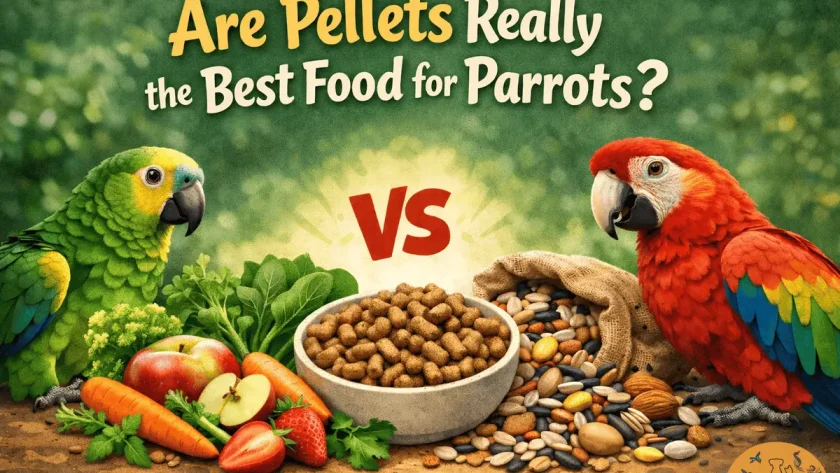
- Around half of the diet can be made up of high-quality pellets
- A good portion should come from fresh vegetables and leafy greens
- A small part may include seeds, nuts, or fruits, depending on the species
Of course, every parrot is different. A Senegal may have different needs than an Eclectus. Still, variety and freshness are always safe principles.
If you’re looking for something practical, a simple daily feeding routine offers a clear way to organize meals and rotate foods in a simple way.
And do birds actually enjoy this kind of mix?
Most do. It may take some time and a few wasted carrots, but parrots adapt. Once they get used to real food variety, many show more energy, brighter feathers, and better overall health.
Others even get more active at mealtime, experimenting with the foods, dipping greens in water, shredding broccoli like it were a toy. Food is not just sustenance but is enrichment.
So are pellets good or bad?
Pellets are good, but not sufficient.
Imagine pellets to be the house. No one lives solely on the basis. What makes a diet complete are the colors, shapes, smells and natural pieces. It is not only about feeding your parrot nutrients. It’s about the experience. Similar to us, parrots also need some pleasure in their food.