
 Guest Author
By Muhammad Zafar Yab Khan
Guest Contributor
Bringing a dog home for the first time is one of those moments you never forget. The first night, the first walk, the first time they fall asleep on your feet like they have known you forever. It is wonderful, and it is also a little overwhelming, because nobody hands you a manual and most of us learn by making mistakes.
I have seen plenty of new owners make the same small errors, and the good news is that almost all of them are easy to fix. Here are the ones that matter most.
Feeding them like a human, not a dog
This is probably the most common mistake of all. A new owner looks at those big eyes staring up from under the table and thinks, surely one small bite of chicken will not hurt. Then it becomes a habit, and before long the dog is eating more of your dinner than their own food.
Stick to a good quality dog food, measure the portions, and keep treats to about ten percent of what they eat in a day. If you want to share something, a piece of plain carrot or a slice of apple without the seeds is a far better choice than whatever is on your plate.
Skipping the routine
Dogs love routine more than most people realise. They feel safest when they know roughly when they will eat, when they will go out, and when they will sleep. When everything is random, some dogs get anxious, and anxious dogs chew things, bark more, and have accidents in the house.
You do not need a military schedule. Just try to keep feeding times, walks, and bedtime roughly the same each day. Puppies especially need to go out often, after meals, after naps, and after play, and a puppy that is taken out regularly learns where to go much faster than one left to guess.
Forgetting that exercise is not just physical
A tired dog is a well-behaved dog, but tired does not only mean walked. A dog that gets a long walk but nothing to think about can still come home and destroy a cushion out of boredom.
Mental exercise matters just as much. A stuffed food puzzle, a short training session, or even hiding a few treats around the room and letting them sniff them out can wear a dog out in a good way. Ten minutes of learning a new trick often tires a dog more than half an hour of wandering around the same block. And a quick note on puppies: their joints are still growing, so very long runs and jumping up and down stairs are best avoided until they are older.
Waiting too long to train
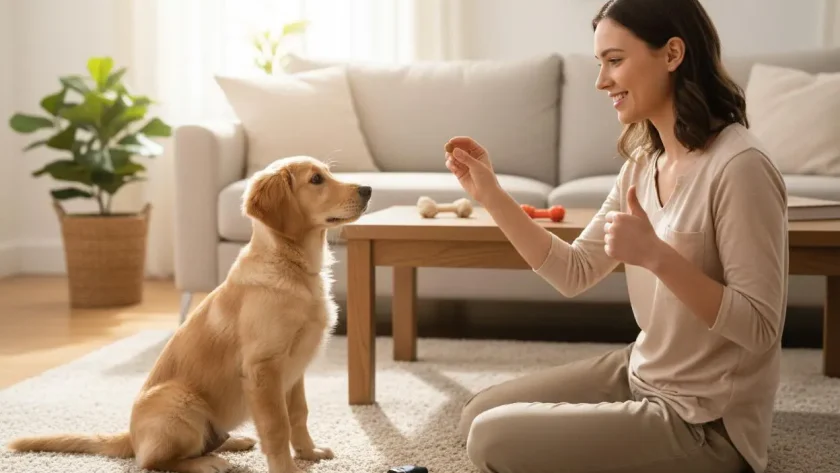
A lot of new owners tell themselves they will start training later, once the dog has settled in. The trouble is that the dog is learning from day one whether you are training them or not. If jumping up gets attention, they learn that jumping up works. If pulling on the lead gets them to the park faster, they learn that pulling works.
Start on the first day, and keep it simple. Reward the behaviour you want, ignore or gently redirect the behaviour you do not want, and keep sessions short and fun. Five minutes a few times a day beats one long frustrated session. And please, skip any training that relies on fear or pain. It might stop a behaviour in the moment, but it damages trust, and trust is the whole foundation of living with a dog.
Socialisation belongs here too. Between roughly three and fourteen weeks old, puppies are at their most open to new experiences. Meeting different people, hearing traffic, and seeing other dogs all help them grow into a confident adult dog, as long as those early meetings are calm and positive.
Missing the small health signs
Dogs are very good at hiding discomfort. In the wild, showing weakness was dangerous, and that instinct is still there. So by the time a dog is obviously limping or refusing food, the problem may have been building for a while.
Get into the habit of really looking at your dog. Are they drinking more water than usual? Is their coat dull, or are they scratching more than normal? Are their gums pale instead of pink? Any of these can be an early warning sign. A vet visit when something seems slightly off is almost always cheaper and easier than a vet visit when it has become an emergency.
Regular vet check-ups, vaccinations, and parasite prevention are the unglamorous backbone of dog care, and they are worth every penny. So is dental care: bad teeth are painful, and most dogs over three have some dental disease.
Leaving them alone too long, too soon
A new dog, especially a puppy, has just left everything familiar. Being left alone for eight hours on the first day is a lot to ask. Separation anxiety often starts exactly this way, with a dog that panics because it was never taught that being alone is safe.
Build it up slowly. Start with a few minutes while you are in another room, then a short trip out. Leave them with something good, like a stuffed toy or a chew, so that your leaving predicts something nice rather than something scary. If your dog is distressed every time you leave, talk to your vet or a qualified trainer early. It is far easier to fix at the start than after months of practice.
The bottom line
Nobody gets everything right on the first day, and that is fine. Dogs are forgiving creatures. What they need most is not a perfect owner, but a consistent one: regular meals, regular walks, a bit of training every day, and someone who pays attention when something seems off.
Get those basics right and the rest falls into place. The reward is a dog that trusts you, listens to you, and is genuinely happy to see you every single time you walk through the door.
About the Author
Muhammad Zafar Yab Khan writes about practical everyday topics for small businesses and pet owners, with a focus on simple advice that actually works in real life.


